
Introduction
Disseminated intravascular coagulation (DIC) is a secondary disruption of the balance of hemostasis, leading to potential life-threatening thrombosis or hemorrhage. The systemic activation of coagulation leads to the deposition of fibrin and microvascular thrombi throughout body, with simultaneous fibrinolysis, leading to multi-organ dysfunction (Belfort 2022a). Approximately 1 to 5 percent of all DIC cases are related to pregnancy-associated DIC (Levi 2009). DIC often results in adverse maternal outcomes including blood transfusion, hysterectomy, and potentially death. The most common obstetric complications that are related to DIC are postpartum hemorrhage, placental abruption, preeclampsia/eclampsia/HELLP syndrome, pregnancy-related sepsis, amniotic fluid embolism, and acute fatty liver of pregnancy (ACOG 2017). Clinical presentation of obstetric DIC often results in overt bleeding and thrombosis, with patients presenting with severe uterine bleeding, and diffuse bleeding from intravenous sites or bladder catheters. Furthermore, signs of shock develop, including hypotension and tachycardia, and/or organ dysfunction (Belfort 2022b).
Early recognition of DIC is critical for management. Diagnosis often occurs simultaneously with treatment, particularly if there is concurrent hemorrhage, shock, or abnormal fetal heart tones. In less fulminant cases, laboratory results will reveal prolonged PTT and PT/INR, thrombocytopenia, elevated D-dimer, and low fibrinogen levels (Callaghan, Creanga, and Kuklina 2021). The management of DIC involves resolution of the underlying disorder – quick delivery or termination of pregnancy, and supportive care with blood transfusion, including early administration of fresh frozen plasma, platelets, and packed red blood cells (Belfort 2022b).
Case Description
07/07/21: Initial presentation @17w6d with leakage of fluid.
FHR: 156 bpm, No contractions noted
Cervical Exam: Visually closed, Pooling +, Nitrazine +, Clear
straw-colored fluid from cervical os, ROMplus +
Diagnosed with nonviable PPROM
Per ACOG recommendation patient is previable with
PPROM, no intervention recommended at this time
Instructed to follow up with clinic in one week, once viable
at 22w5d, Betamethasone for fetal lung development and
Magnesium Sulfate infusion for neuroprotection would be
done
07/22/21 @2301:
Return to hospital @20w5d for vaginal bleeding
FHR: 156 bpm, No contractions noted
Cervical Exam: Unable to visualize cervix d/t vaginal
bleeding, Speculum: Bright red bleeding, no clots
SVE 0.5//0/-3 è admit + abruption labs drawn
07/23/21 @0041:
Patient placed in room, seen for vaginal bleeding and
bleeding from mouth, no bleeding from IV sites
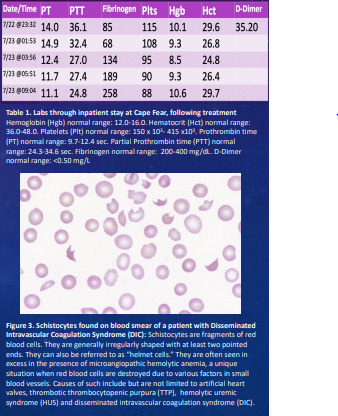
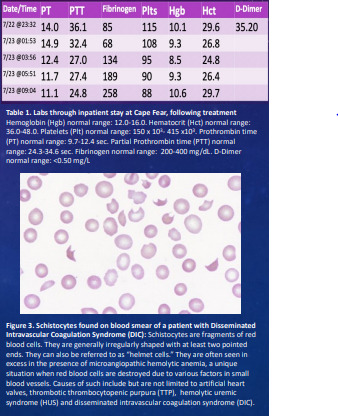
CBC, Fibrinogen, D-Dimer and coagulation labs drawn
07/23/21 @0219:
Discussed lab results of increased PT/PTT, low fibrinogen,
low hemoglobin, low hematocrit and elevated D-Dimer
with thrombocytopenia
U/S revealed placental abruption
MFM consulted who recommended proceeding with IOL at
this time via buccal Cytotec
FFP, pRBCs and Cryoprecipitate ordered for placental
abruption and possible DIC
07/23/21 @0231:
Rapid response called for DIC
Internal medicine and hematology on-call physician
consulted
Q 1-hour labs ordered
07/23/21 @0341:
Hematology recommended another two units of FPP,
cryoprecipitate amount correct
Recommended removing offending cause, this case
patient’s nonviable pregnancy and placental abruption
while providing adequate clotting factor and blood product
replacement as necessary
Discussed need for goal fibrinogen of >200, platelets >100,
hemoglobin >10 in case need of emergent C/S
Patient received 20 units of cryoprecipitate and 2 units of
FFP
1 unit of pRBCs + TXA ordered
07/23/21 @0515:
Due to increase in bleeding, another unit of pRBCs
ordered at this time, most recent Hgb 8.5
07/23/21 @0726:
Patient experiencing contractions every 2 minutes,
cervix 3/60/-3
1 unit of Plts and 5 additional units of Cryo ordered
07/23/21 @0829:
Fetus delivered at this time, QBL 924 mL
IV Pitocin, Cytotec 1000 mcg PR x1, Methergine x1 dose
given for bleeding
07/23/21 @1337:
Patient stable on postpartum currently with scant
vaginal bleeding and no pain
No further transfusions needed at this time; next lab
due at 1800
07/24/21 @0608:
Patient meeting all postpartum milestones
All labs within goal range. No further transfusions
needed
Patient left AMA due to childcare issues, patient agreed
to follow up at clinic in one week
Labs (Callaghan, Creanga, and Kuklina 2021):
Discussion
Disseminated Intravascular Coagulation Syndrome develops in approximately 0.03-0.35% of pregnancies overall and has a reported prevalence of 12.5 per 10,000 delivery hospitalizations (Belfort 2022b). The prevalence of pregnancy-associated DIC is low, patients with specific pregnancy complications, such as amniotic fluid embolism or placental abruption as in this patient, can be at very high risk with a prevalence of >20% (ACOG 2017).
Conclusions
Diagnosis of acute DIC in a pregnant patient is made when the clinical setting is appropriate and there is laboratory evidence of consumptive coagulopathy that includes coagulation factor consumption (prolonged PT/PTT, low fibrinogen), fibrinolysis (increased D-dimer) and thrombocytopenia with or without active bleeding (Callaghan, Creanga, and Kuklina 2021). DIC should be considered in the setting of placental abruption, Preeclampsia with severe features/eclampsia/HELLP syndrome, amniotic fluid embolism, acute fatty liver of pregnancy, and septic abortion in pregnancy so that appropriate treatment is not delayed (ACOG 2017). Appropriate recognition and treatment will reduce both morbidity and mortality for the patient.